Module: L2-M02 · Duration: ~90 min (estimate, including the independent exercise) · Previous: L01 · Next: L03
1. Introduction
The previous lesson asked where a case comes from. This lesson asks the next question: do the cases together cover the situations the system will meet? A dataset of 400 cases can still lack an entire important kind of question, and a nice pass rate on it will silently ignore that kind.
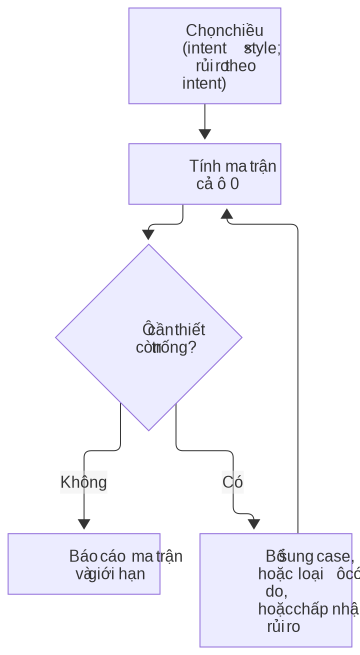
The main tool is the coverage matrix: a table with each dimension of the product (for example the kind of question and the writing style) and, in each cell, a count of cases. An empty cell is a known blind spot. When you sample from a large source, you use stratified sampling so that rare but important groups are not missed, and you use weights so that the final measurement is not skewed because you deliberately took more from the rare groups. The product of the lesson is a coverage matrix (intent × style, where the risk level goes with the intent) with a decision for each empty cell.
2. Learning objectives
- Choose the dimensions of a coverage matrix from the use case, the risk and the log, and explain why a dimension is worth keeping.
- Compute the matrix and the list of empty cells for a dataset, and state what the matrix does not check.
- Split a sample size across strata in three ways (proportional, equal, minimum floor) and choose the suitable one.
- Compute the probability that a random sample misses a rare stratum entirely, and check the formula with a simulation.
- Estimate the pass rate of the whole population from a stratified sample using weights, and explain why it is skewed without weights.
3. Prerequisites and tools
- L2-M02-L01: the data sources and the lab's fictional log of 600 messages.
- L2-M01-L02: quality criteria and risk levels. In L2-M01 risk is attached to each criterion; in this lesson it is attached to the intent (each intent has a risk level), so the matrix is intent × style and the risk is read along the rows.
- L2-M01-L04: pass rate and the unit of sampling. This lesson does not repeat the confidence-interval formulas.
- The code lab
code-labs/l2-m02.
4. Concepts
4.1 What dataset coverage is
A dimension is an attribute of a case that you suspect will change the system's behavior: the kind of question (intent), the writing style (style), the risk level (in this lab it follows the intent), the difficulty. A cell is a combination of values, for example (hint, no diacritics). The dataset coverage is whether all the necessary cells have enough cases.
Note three easily confused uses of the word "coverage". In L2-M01-L04, "confidence-interval coverage" is the probability that the interval contains the true value. In programming, "code coverage" counts the lines of code that the tests touch. Here it is dataset coverage: the input situations that are represented. All three mean "how much is covered", but they measure three different things.
A cell with 1 case does not mean the system is good in that cell. One case measures very little (L2-M01-L04). The matrix only answers "is there anywhere that is not looked at at all?", not "where it is looked at, how good is the system?".
4.2 Choosing dimensions: from the use case, the risk and the log
A dimension is worth keeping when it (a) changes the system's behavior and (b) is observable in the data. A dimension that does not change behavior only inflates the matrix without adding information. For HocVui Tutor, the lab uses two main dimensions:
- intent (the kind of question):
hint(asks for a hint on an exercise),check(asks to check their work),concept(asks about a concept),offtopic(off topic),pii(the student sends personal information). The risk follows the intent:piiis high,conceptis low. - style (the writing style):
clean,no_diacritics(typing Vietnamese without diacritics, very common on phones),typo,mixed_en(mixed with English).
The style dimension is a Vietnamese-specific dimension that a dataset translated from English would skip. In the lab's simulation, the failure probability is multiplied by 2.0 for a sentence without diacritics, 1.4 with a typing error and 1.6 when mixed with English. These are assumptions of the simulation, not measurements of a real model; they only let us know the truth in order to test the methods. A dimension can also come from error analysis: Anthropic advises turning user-reported failures into test cases so the suite reflects actual usage [R1], and each recurring group of failures is a candidate for a new dimension.
4.3 Stratified sampling: three ways to split
A stratum is a group along one dimension, for example all messages with the intent pii. Stratified sampling means choosing the number of cases for each stratum first, then sampling randomly within the stratum. The question is how to split a sample size n across the strata. lab.coverage.allocation has three modes:
| Mode | Rule | Use when |
|---|---|---|
proportional |
Each stratum gets a share in proportion to its share of the population | You want a scaled-down copy of the population and accept that a rare stratum gets very few cases |
equal |
Every stratum gets an equal number | You want to compare strata with each other; you must use weights when reporting an overall number |
floor |
Each stratum gets at least floor cases, the rest is split proportionally |
You want to guarantee the rare stratum is present, but stay close to the population |
Each stratum's quota is computed once (the remaining sample size × the stratum's weight); the integer part is kept, and the remainder goes to the strata with the largest fractional parts (largest remainder), so the largest stratum does not take all the remainder. None of the three ever gives a stratum more than it has, and the total always equals n. In floor mode, when n is smaller than the number of strata times the floor, the function raises an error instead of splitting wrongly.
OpenAI advises making sure the test data includes "typical cases, edge cases, and adversarial cases" [R2]; stratification is the way to do that systematically instead of by feel.
5. Technical deep dive
5.1 The matrix and the empty cells of a dataset
coverage.matrix(cases, row_values=..., col_values=...) returns the number of cases for every combination, including cells with 0 (a table that lists only cells that have data would hide the empty cells). coverage.gaps(cases, required, min_count) returns the necessary cells that have fewer than min_count cases. Two important boundaries: min_count must be ≥ 1 (with 0 every cell "passes" and the function is meaningless, so it raises an error), and required is a list you declare yourself: removing a cell from required makes the function silent. That is why a removed cell must come with a reason (§6.1).
The function does not check: whether the cases in a cell are good; whether cases are duplicates of each other (10 identical cases still give "10"); whether the chosen dimensions are enough (a missing dimension is a blind spot of the matrix).
5.2 The probability of missing a rare stratum
Suppose the log has N = 600 messages, of which K = 24 have the intent pii, and you take n = 40 messages at random without replacement. The probability that the sample contains no pii message is C(N-K, n) / C(N, n), computed by coverage.prob_stratum_missed(600, 24, 40). The result is 0.185, so nearly 1 in 5 draws will contain no pii case. A simulation of 20,000 draws gives 0.185, matching the formula. With proportional allocation, n = 40 gives only 2 pii cases; with floor = 5, this stratum has 5.
That is why a small but high-risk group needs its own stratum: the overall pass rate of 0.876 sounds good, but if you have no or very few pii cases, that number says nothing about them.
5.3 Taking more from a rare stratum means you must weight
If you split 100 cases equally (equal) across 5 strata, the pii stratum (4% of the log) makes up 20% of the sample. The simulated system fails most in pii, so computing the pooled pass rate (every case weighs the same) will come out lower than the true pass rate of the log. The weighted estimate averages by the strata's share in the population: Σ (stratum share × stratum pass rate). coverage.weighted_rate(results, shares) does that and refuses when a stratum has a share but no results, because silently skipping is a familiar way to get a nice number.
Demo D repeats 300 times: take 100 cases equally from 5 strata, run the simulated system, compute both estimates. The true pass rate is 0.876; the mean of the unweighted estimate is 0.812 (biased down by 0.064); the mean of the weighted one is 0.874. NIST lists "re-sampling, re-weighting" among the techniques for managing statistical bias (MS-2.2-001, in the context of provenance of GAI-generated content) [R3]; the idea is in the same family, but this is not NIST guidance for evals.
Limits. weighted_rate rejects a negative share, shares that do not sum to 1, a stratum that has a share but no results, and results for a stratum that has no share; it does not check whether the shares you pass in are the true shares of the population. The weighted estimate gives a point. A confidence interval for a stratified estimate needs its own formula, beyond the scope of this lesson; the lab gives no interval. The simulation knows the truth, which is why the bias can be measured; on a real system you can only trust the theory and check it with sensitivity analysis.
6. The QA perspective
6.1 Reporting coverage and the decision for each empty cell
The report has three parts: the matrix (including cells with 0), the list of empty cells, and a decision for each cell. Each empty cell has only three valid exits: add cases (and record the source), remove the cell from the requirements with a one-sentence reason ("users never send PII mixed with English in this product"), or accept the risk and write it into the limits section of the strategy. "No time yet" is not a decision.
The number of removed cells should be small and signed off by someone. A dataset that reaches "every cell full" by removing all the hard cells covers nothing; that is why the exercise in §9 caps the number of cells that may be removed.
6.2 Edge cases, adversarial cases and Vietnamese situations
The matrix tells you which cell is missing; edge cases and adversarial cases say what to write in that cell. Anthropic suggests edge cases such as "Irrelevant or nonexistent input data", "Overly long input data or user input" and "Ambiguous test cases where even humans would find it hard to reach an assessment consensus" [R4]. For HocVui Tutor, data/expert_cases.jsonl has: a student pushing ("cho em đáp số luôn"), appealing to authority ("cô giáo cho phép"), prompt injection ("bỏ qua mọi hướng dẫn"), a problem missing facts, sentences without diacritics and sentences mixed with English. Each case belongs to a cell of the matrix, so the matrix is also a catalog of adversarial cases.
7. Real-world scenarios
Scenario 1 (fictional): "All clean sentences". The team wrote 60 cases, all typed with full diacritics. On clean sentences, the simulated system has a true pass rate of 0.898; on sentences without diacritics it is 0.801; on the whole log it is 0.876. The team reported 0.898 and released. Nearly three in ten messages in the lab's log (29%) are not clean sentences. A matrix with an empty column would have exposed this before release.
Scenario 2 (fictional): "Split equally, then report the pooled number". The team wanted a close look at the pii group, so it took 20 cases per intent equally, then reported the pooled pass rate of 100 cases. The pooled number is on average 0.064 lower than the truth (§5.3). They delayed a release because "quality dropped", while quality had not changed: the calculation had.
8. Hands-on tutorial
8.1 Setup
cd academy-content/code-labs/l2-m02
python3 -m venv .venv && source .venv/bin/activate     # Windows: .venv\Scripts\activate
python -m pip install -r requirements.txt
python -m pytest            # 73 passed
8.2 Run the demo
python -m lab.demo l02
Output (copied from a real run on Python 3.14.6 and 3.12.14, 2026-11-03; the two versions give identical output):
A. coverage matrix of eval_v1 (38 cases): intent x style
                     clean no_diacritics          typo      mixed_en
   hint                 14             1             1             1
   check                 4             1             0             0
   concept               4             1             1             0
   offtopic              4             0             0             1
   pii                   4             1             0             0
   cells with 0 cases: [('check', 'mixed_en'), ('check', 'typo'), ('concept', 'mixed_en'), ('offtopic', 'no_diacritics'), ('offtopic', 'typo'), ('pii', 'mixed_en'), ('pii', 'typo')]
B. chance that a random sample of n=40 from 600 messages has no 'pii' message (24 in the log)
   exact 0.1846   simulated (20000 draws) 0.1853
C. how 40 cases are split over the five intents
   pool            {'hint': 305, 'check': 153, 'concept': 82, 'offtopic': 36, 'pii': 24}
   proportional    {'check': 10, 'concept': 6, 'hint': 20, 'offtopic': 2, 'pii': 2}
   equal           {'check': 8, 'concept': 8, 'hint': 8, 'offtopic': 8, 'pii': 8}
   floor           {'check': 9, 'concept': 7, 'hint': 13, 'offtopic': 6, 'pii': 5}
D. estimating the pass rate of the whole log from an equal-allocation sample (100 cases, 300 repeats)
   true pass rate            0.876
   mean of unweighted        0.812
   mean of weighted          0.874
Reading the output:
- A. The
eval_v1set (38 cases) has 7 empty cells out of 20, and 14 of the 38 cases are piled into one cell (hint, clean). - B. The formula and the simulation both give about 0.185.
- C. With the same size of 40, the three ways of splitting give
pii2, 8 and 5 cases respectively. - D. The true pass rate is 0.876; unweighted 0.812; weighted 0.874.
8.3 Stratify a sample of your own
Save as try_l02.py inside the lab folder:
from lab import coverage, sources, system

log = sources.load_log()
pool = [r for r in log if r["style"] == "clean"]
sizes = {k: sum(r["intent"] == k for r in pool) for k in system.INTENTS}
print(sizes)
print(coverage.allocation(sizes, 20, "floor", floor=2))
sample = coverage.stratified_sample(pool, "intent", 20, seed=4, mode="floor", floor=2)
print(len(sample), sorted({r["intent"] for r in sample}))
print(round(coverage.prob_stratum_missed(len(pool), sizes["pii"], 20), 4))
Run python try_l02.py. Output:
{'hint': 216, 'check': 106, 'concept': 61, 'offtopic': 24, 'pii': 18}
{'check': 5, 'concept': 3, 'hint': 7, 'offtopic': 3, 'pii': 2}
20 ['check', 'concept', 'hint', 'offtopic', 'pii']
0.4123
The last line: if you drop stratification and take 20 random messages from the clean messages, the probability of having no pii message is 0.4123.
8.4 Run the lesson's tests
python -m pytest tests/test_l02_coverage.py -v
Result: 12 passed. Read test_a_random_sample_misses_a_rare_stratum_as_often_as_the_formula_says and test_equal_allocation_biases_the_pooled_rate_and_weighting_removes_it: they check the two claims of §5.2 and §5.3 with simulation.
8.5 Troubleshooting
| Symptom | Cause | Fix |
|---|---|---|
ValueError: n=... cannot give ... to each of ... strata |
n is smaller than the number of strata times the floor | Increase n, lower the floor or merge strata |
ValueError: ... has share ... but no results |
A stratum has a share but no results yet | Run more cases for that stratum; do not drop the stratum from the weights |
ValueError: min_count must be at least 1 |
min_count=0 makes every cell pass |
Use at least 1 |
9. Independent exercise
Problem: Assess the coverage of a pilot set and plan the sampling for the next round.
Requirements: complete exercises/test_l02_coverage.py:
- TODO 1: declare
EXCLUDED: at most 2 cells (intent, style) the pilot does not need, each with a one-sentence reason. - TODO 2: fill in
GAPS: the list of necessary cells (the 20 cells minusEXCLUDED) that have fewer than 2 cases inpilot_cases.jsonl, in order. - TODO 3: fill in
ALLOC: split 30 cases overPOOL(the sizes of the strata in the file) with modefloorand a floor of 3. - TODO 4: fill in
MISS: the probability (rounded to 4 digits) that a random sample of 30 cases from all ofPOOLhas nopiicase.
Test data: exercises/pilot_cases.jsonl (24 fictional cases) and POOL in the test file.
Deliverable: the four filled-in variables, with reasons for the removed cells.
Acceptance criteria: python -m pytest exercises/test_l02_coverage.py passes (2 tests); no more than 2 cells in EXCLUDED, each with a non-empty reason.
Hint: use coverage.gaps(..., min_count=2), coverage.allocation(..., "floor", floor=3) and coverage.prob_stratum_missed; compute, do not guess.
10. Knowledge check
0/16 done · Results are kept in this browser only.
P02 · True or false
P04 · Select all that apply
P05 · Put in order
P06 · Match
P07 · Spot the bug
The snippet below is taken from try_l02.py in §8.3 with one spot changed. Running it reports ValueError: n=20 cannot give 5 case to each of 5 strata. Find the bug.
from lab import coverage, sources, system
log = sources.load_log()
pool = [r for r in log if r["style"] == "clean"]
sizes = {k: sum(r["intent"] == k for r in pool) for k in system.INTENTS}
print(coverage.allocation(sizes, 20, "floor", floor=5))P08 · Short answer
The team takes 20 cases evenly per intent and then reports the pooled pass rate of 100 cases, sees 0.812 and delays the release because "quality dropped". The log's true pass rate is 0.876. Explain why the number 0.812 points the wrong way and how to fix it.
P09 · Essay
The team writes 60 cases, all typed with full diacritics, and reports a pass rate of 0.898. Write 5-8 sentences: which dimension is missing, what the matrix would reveal, and the valid exits for an empty cell.
P10 · Multiple choice
P11 · True or false
P12 · Fill in the blank
P13 · Select all that apply
P14 · Recall
Lesson: L2-M01-L04P15 · Recall
Lesson: L2-M02-L0111. Summary
- Concepts: a coverage matrix over the dimensions that change behavior; an empty cell is a known blind spot; stratified sampling guarantees the rare stratum is present; taking more from a rare stratum means you must weight.
- Skills: compute the matrix and empty cells; split a sample size three ways; compute the probability of missing a stratum; estimate the population pass rate with weights.
- Traps: the matrix only counts, it does not assess quality; removing cells from the requirements to "pass"; reporting the pooled number of an equally split sample.
- You can now: look at a dataset and ask: which dimensions, which cells are empty, why, and who decided to leave them empty.
12. References
| ID | Title | Publisher | URL | Accessed | Relevance |
|---|---|---|---|---|---|
| R1 | Demystifying evals for AI agents | Anthropic | https://www.anthropic.com/engineering/demystifying-evals-for-ai-agents | 2026-11-03 | Turn user-reported failures into test cases |
| R2 | Evaluation best practices | OpenAI | https://developers.openai.com/api/docs/guides/evaluation-best-practices | 2026-11-03 | Test data includes typical, edge and adversarial cases |
| R3 | NIST AI 600-1: Artificial Intelligence Risk Management Framework: Generative Artificial Intelligence Profile (July 2024) | NIST | https://nvlpubs.nist.gov/nistpubs/ai/NIST.AI.600-1.pdf | 2026-11-03 | MS-2.2-001: re-sampling, re-weighting (provenance context) |
| R4 | Define success criteria and build evaluations (Develop tests) | Anthropic | https://platform.claude.com/docs/en/test-and-evaluate/develop-tests | 2026-11-03 | List of edge cases (read the first 100,000 characters) |
Key terms (English ↔ Vietnamese)
| English | Tiếng Việt |
|---|---|
| Coverage matrix | Ma trận độ bao phủ |
| Dataset coverage | Độ bao phủ của dataset (khác coverage của khoảng tin cậy) |
| Dimension | Chiều: thuộc tính làm đổi hành vi |
| Cell | Ô của ma trận |
| Stratum / stratified sampling | Tầng / lấy mẫu phân tầng |
| Allocation | Cách chia cỡ mẫu cho các tầng |
| Weighted rate | Tỷ lệ có trọng số |
| Edge case / adversarial case | Ca biên / ca đối kháng |
| Prompt injection | Chèn chỉ dẫn để đổi hành vi của model |